The 2023–2024 GenAI wave was dominated by pilots: copilots, chat interfaces, quick automations, internal “LLM sandboxes.” By 2026, the center of gravity shifts. AI is no longer a “tool employees try”, it’s a runtime component inside business workflows:
A developer copilot that can read repo context, propose patches, and trigger CI actions
A support agent that drafts responses while pulling context from CRM and knowledge bases
An ops agent that investigates alerts, queries logs, and recommends remediations
A knowledge agent embedded in tools like Notion/Slack/Docs that continuously rewrites and summarizes work artifacts
Security changes when AI becomes infrastructure, because the primary risk stops being “someone pasted secrets into a prompt.” The risk becomes decision-making + tool execution at scale, where a model can:
interpret untrusted inputs,
form a plan, and
call tools that modify systems of record.
That’s why 2026 is a maturity year: AI adoption is forcing enterprises to build the equivalent of a control plane for AI policies, enforcement, monitoring, and auditability, not as PowerPoints, but as runtime controls.
1) The CIO agenda: AI spend implies AI security spend
One of the most useful ways to read CIO funding trends is: any serious GenAI spend creates a parallel “security & governance” spend, whether planned or not.
As AI moves from pilots to production, security requirements emerge that are hard to bolt on later:
What changes technically when AI goes “production”?
More integration points: LLMs connect to APIs, internal services, SaaS, and data stores.
More identities: users, service accounts, agent identities, tool identities.
More implicit trust: systems start accepting AI outputs as “good enough” inputs to other systems.
More surface area: prompt inputs include web pages, emails, docs, tickets, logs, code, screenshots, and transcripts.
More speed: agent frameworks can execute chains of actions faster than a human can review.
In cloud, we learned this as “cloud adoption created cloud security spend.” In AI, the pattern repeats, but with one critical difference: agentic execution turns mistakes into operational incidents, not just data incidents.
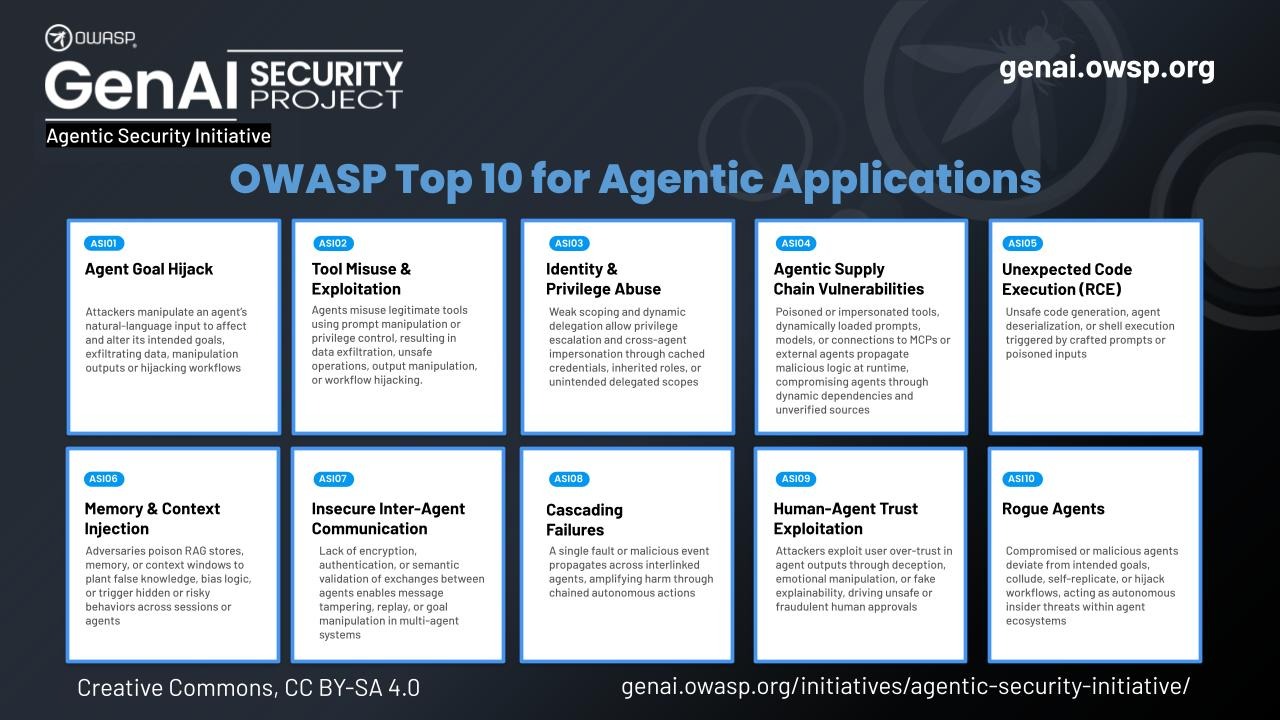
2) OWASP Agentic AI Top 10: why it’s not “just another list”
OWASP’s Agentic AI Top 10 matters because it defines the new failure modes of AI systems that can act. In classic AppSec, we defend deterministic code paths: inputs → processing → outputs. In agentic AI, the “processing” step includes planning and tool invocation, which is where many real-world failures occur.
The technical shift OWASP is pointing at
In an agentic system, the attack surface spans:
Inputs
user prompts
retrieved documents (RAG)
web content (browsing)
email and chat content
tool outputs (logs, database results, API responses)
The important security implication: untrusted content can become executable intent. OWASP’s model is essentially saying: you have to treat the agent’s reasoning loop as a high-value control boundary.
Why “agentic” makes things harder than classic prompt injection
Prompt injection in a chatbot is often “bad output.” Prompt injection in an agent is “bad output + tool execution.”
The delta is massive:
An injected instruction can cause state changes (tickets, workflows, IAM changes, data exports).
Chains of tool calls can produce cascading consequences across multiple systems.
Memory poisoning makes it persistent (risk survives beyond a single interaction).
Human trust exploitation turns “human approval” into an attack primitive.
So the real contribution of the OWASP Agentic Top 10 is not taxonomy, it’s a security model: intent validation + action governance become as important as input sanitization.
3) Regulation in 2026: controls move from “policy” to “proof”
By 2026, the compliance conversation shifts from “we have an AI policy” to “show me the controls.”
EU: AI Act pressure translates into operational requirements
Even if your enterprise is not building a foundation model, most large organizations will touch regulated use cases indirectly:
HR screening workflows enhanced by AI
customer-facing decisioning support
AI-augmented customer support
AI in critical process automation
Regulators will increasingly ask for evidence of:
system classification / risk assessment
documented governance and oversight
traceability (how outputs were produced)
monitoring and incident response
controls for high-risk behaviors and outcomes
This pushes orgs toward audit-grade telemetry and runtime enforcement, not “best effort.”
US: baseline frameworks + sector pressure
The U.S. is less centralized, but the direction is consistent: NIST AI RMF-style governance becomes the “reasonable precautions” standard, and sector regulators want the ability to demonstrate risk management. Practically, that means:
documented controls
ongoing monitoring
incident handling processes
explainability and traceability for sensitive workflows
The shared reality: you can’t govern what you can’t observe and you can’t prove controls without traceability.
(Include external links to EU AI Act overview and NIST AI RMF.)
4) The operational shift that matters: from “block AI” to “govern AI in production”
The “ban” phase failed because AI isn’t one app anymore it’s embedded inside sanctioned platforms, plus employees adopt “shadow AI” anyway. The mature posture is governance built on engineering principles:
What does “govern AI” mean technically?
It means enforcing and validating:
Data controls — what data can enter/leave models
Identity & scope — who/what is acting, and with what permissions
Intent controls — why the action is happening in this context
Action controls — what tool calls are allowed, with what parameters
Auditability — how to reconstruct what happened later
If you only have (1), you’ll miss most agentic failures. If you only have (5), you’ll find out too late.
The key new idea: intent becomes a security boundary
Traditional controls look at:
destination (where is data going?)
content class (is it PII?)
identity (who is doing it?)
Agentic AI needs an additional layer:
purpose and alignment: “is this action aligned to the user’s objective and business policy?”
That’s not philosophy, it’s a practical security control. Example: a support agent asked to “summarize an incident” should not export full log bundles to an external host. Same identity, same system, same tool, different intent.
5) What “AI security spend” will actually fund (technical buckets)
As budgets expand, spending will cluster into controls that map to the AI lifecycle:
A) LLM interaction controls (prompt + response governance)
redaction / masking
sensitive data detection
policy checks on prompts and outputs
response shaping (block / redact / allow with warnings)
model routing (which model can handle which task)
B) Agent execution controls (tool and workflow governance)
tool allow/deny lists
parameter constraints (e.g., no “DELETE”, no “export all”, no cross-tenant access)
rate limiting and step boundaries
approval gates for irreversible actions
drift detection across multi-step plans
C) Observability & auditability (security operations for AI)
prompt, tool-call, and action logs with correlation IDs
D) AI supply chain controls (models + plugins + dependencies)
Even without going deep into SBOM-for-models, the core idea is the same:
provenance and approval of models/plugins
monitoring of new integration points
governance over what becomes a “trusted capability” inside your environment
The overarching theme: enterprises are building an AI control plane the same way they built cloud control planes but with deeper runtime enforcement because the system can act.
We think 2026 will be the year enterprises stop treating AI risk as “novel” and start treating it as operational security with controls that are enforceable, measurable, and auditable.
That’s why QuilrAI is designed around two complementary governance points:
LLM Gateway: governs what users/apps/agents ask and what models return
MCP Gateway: governs what agents do when they execute actions via tools/APIs
Together, this maps cleanly to the real agentic security lifecycle:
intent → decision → execution → proof
It’s not about fear-driven “don’t use AI.” It’s about enabling AI adoption at scale with the controls CISOs and governance leaders need:
visibility into what’s happening
policy-as-code enforcement
guardrails that don’t break workflows
auditable outcomes
Closing thought: the 2026 security winners will be control-plane builders
2026 won’t be defined by whether companies adopted AI. Almost everyone will. It will be defined by who can adopt AI confidently at scale without turning automation into a new attack path.
The winners will:
treat untrusted content as executable influence
govern agent actions like privileged operations
build runtime guardrails, not static policies
log and prove control like a regulated system
And that’s the real turning point: AI security becomes less about novelty, and more about engineering discipline applied to intelligent systems.


.png)